

Los Angeles ADU Insurance: What Changes When You Rent Out a Guest House?
Los Angeles property owners are getting creative with space. A detached guest house, garage conversion, or backyard ADU can create real rental income, especially in neighborhoods where every extra unit matters.
But there is one question owners often ask too late: “Is my ADU actually covered the way I think it is?”
The answer depends on how the property is being used, whether the ADU is attached or detached, whether it is rented, and how the insurance carrier views the setup. At Broadway Insurance Services, we see this come up often with Los Angeles owners who are turning part of their property into income.
Renting out an ADU changes the insurance conversation
A homeowner’s policy is usually built around an owner-occupied home. Once a guest house, garage conversion, or ADU is rented to someone else, the insurance conversation changes.
That does not always mean you need a completely separate policy. Sometimes the ADU can be scheduled or handled within a broader landlord policy. Other times, the main home and ADU may need to be treated differently.
A few details can change the answer:
-
Is the main house owner-occupied or rented?
-
Is the ADU attached or detached?
-
Is the ADU rented long-term, furnished, vacant, or used occasionally?
-
Does the ADU have a separate address or utilities?
-
Is the property owned personally, by an LLC, or in a trust?
-
Is there a lender asking for evidence of insurance?
These details matter because the policy should match the real use of the property. If a carrier thinks a property is owner-occupied, but part of it is being rented, that can create problems later.
Main house plus ADU: one property, more moving parts
A main home with a detached ADU may feel like one property to the owner. To an insurance carrier, it may look like multiple structures, multiple occupancies, and more liability exposure.
That is especially true if the ADU is rented separately. A tenant, guest, delivery driver, contractor, or visitor could create a liability claim. There may also be questions about the structure itself, loss of rents, shared walkways, detached garages, gates, stairs, or other property conditions.
This is why ADU insurance should not be treated as an afterthought. If you are adding rental income to the property, the insurance needs to be reviewed with that income use in mind.
For owners who are building a broader rental-property strategy, this is also where a dedicated landlord insurance review can help. You can visit our Landlord Insurance page for more information about coverage options for ADUs, 1-4 family rentals, LLC-owned properties, and small rental portfolios.
Los Angeles ADUs can also create compliance questions
Insurance is separate from rent-control compliance, but the two issues often show up together.
The Los Angeles Housing Department explains that ADU and JADU treatment under the Rent Stabilization Ordinance can depend on facts like whether the original structure was built before October 1, 1978, whether the ADU is attached or detached, and whether the unit was converted from habitable or non-habitable space (LAHD).
That does not mean your insurance broker is replacing your attorney or property manager. It does mean your insurance broker should understand the property setup. If the property has an ADU, tenant, LLC, lender, or rent-control issue, those facts should not be hidden from the insurance conversation.
What should an ADU owner review?
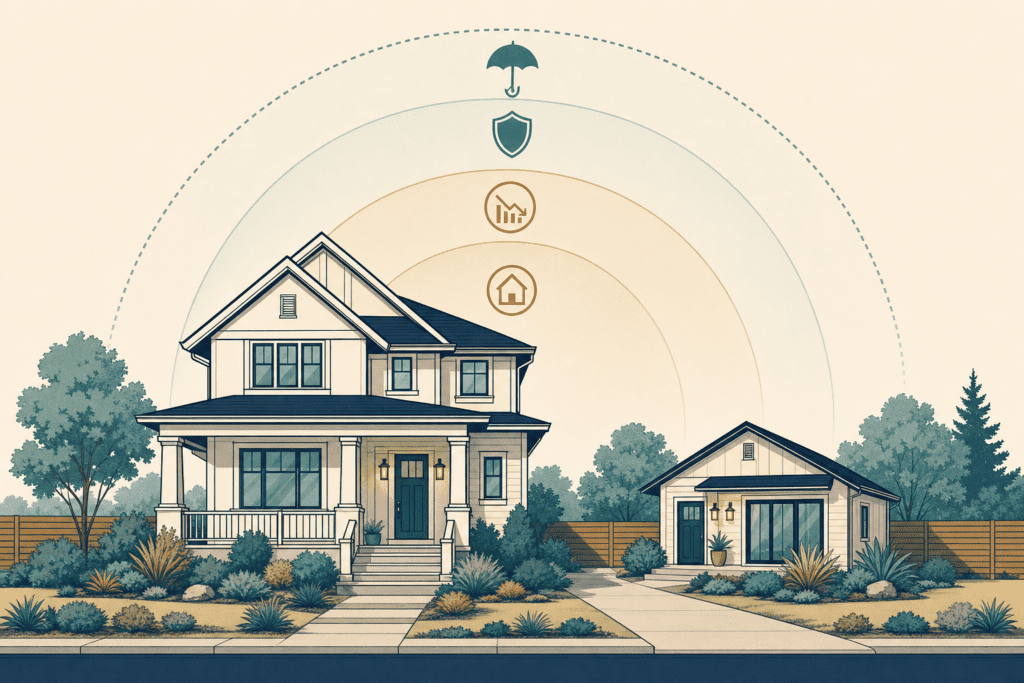
Before renting out an ADU in Los Angeles, review the following items.
Property coverage
Make sure the main dwelling, ADU, garage conversion, or detached structure is properly reflected. If the ADU is not clearly listed or contemplated, you should ask how the carrier is treating it.
Liability coverage
A rental property creates liability exposure. If someone is injured on the property and claims the owner was responsible, the liability limit matters.
Loss of rents coverage
If a covered loss makes the ADU or rental unit uninhabitable, loss of rents coverage may help replace rental income during the covered repair period. For an owner relying on ADU income, this can be an important part of the conversation.
Named insured
If the property is owned by an LLC, trust, or corporation, the policy should be reviewed so the named insured matches the ownership structure and any lender requirements.
Umbrella or excess liability
For many rental property owners, the base landlord policy is only one layer. An umbrella or excess liability policy may provide additional liability protection above the underlying landlord policy, depending on eligibility and carrier guidelines.
This is especially worth reviewing if you own multiple properties, have higher personal assets, own in an LLC, or have tenant and guest exposure across more than one location.
Short-term or furnished rental use
This should be disclosed upfront. Even if short-term rental is not your main business model, Airbnb, Vrbo, furnished rental, mid-term rental, or occasional guest use can change the underwriting conversation.
Do you need a separate ADU policy?
Sometimes yes. Sometimes no.
A separate policy may be more likely if the ADU is detached, separately addressed, rented independently, used for short-term stays, or treated by the carrier as a separate exposure. In other cases, the ADU may be scheduled or handled as part of a broader landlord policy.
The key is not to guess.
A Los Angeles property with a main house, detached ADU, tenant, LLC, and lender deadline can look simple from the street, but it can become complicated quickly in underwriting.
Broadway can help review the setup
Broadway Insurance Services helps property owners review coverage options for landlord, ADU, guest house, garage conversion, duplex, triplex, fourplex, and small rental portfolio situations.
If you are renting out an ADU or planning to turn part of your property into rental income, send us the property address, occupancy details, ownership structure, and any lender requirements. We can help review whether the coverage should be handled as part of a landlord policy, scheduled structure, separate policy, or broader liability plan.
Call Broadway Insurance Services at 213-221-1247 or contact us here to request a landlord insurance review.

