
The short answer
Yes, you can get off the California FAIR Plan in 2026, but not by waiting for your renewal. A broker who can shop admitted carriers and the surplus lines market has to re-shop your address before every renewal.
-
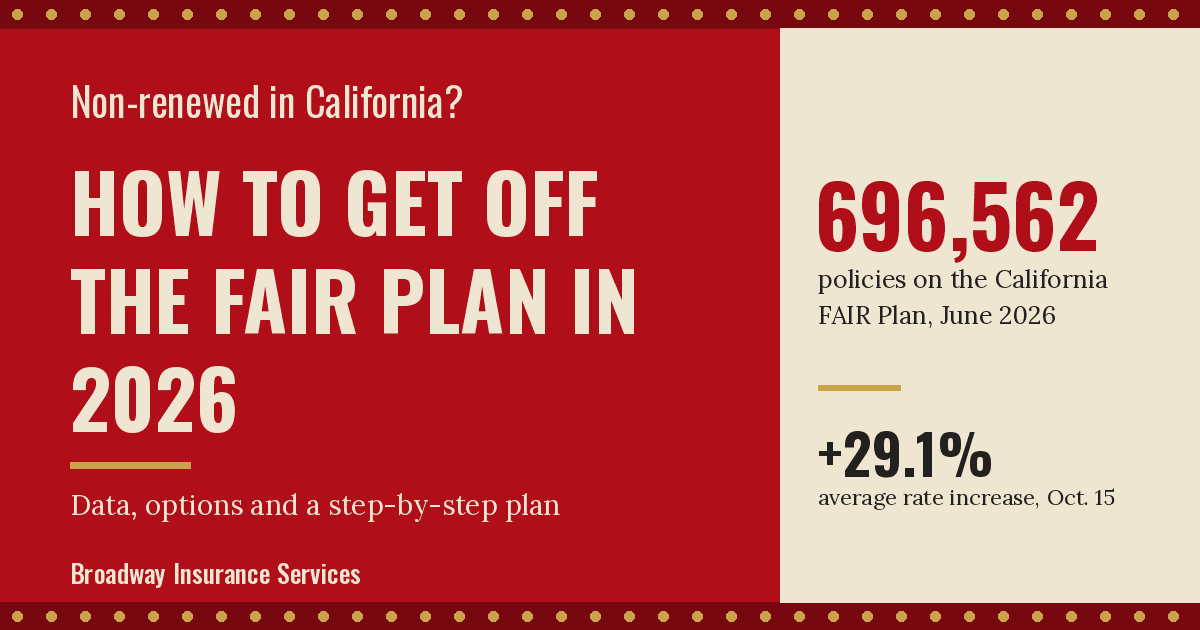
The FAIR Plan has never been bigger. It held 696,562 policies and $768 billion of exposure through June 2026 (California FAIR Plan key statistics).
-
It just got more expensive. The state approved a 29.1% average dwelling rate increase, effective October 15, 2026. The plan had asked for 35.8% (OC Register via InsuranceNewsNet).
-
The FAIR Plan is now a suburban problem. In our analysis of the plan’s county data, Orange County policies grew 74% in one year. Riverside grew 70%, Ventura 60% and San Diego 58%.
-
Surplus lines is the real alternative. New surplus lines homeowners policies in California went from roughly 50,000 in 2023 to 320,000 in 2025 (Insurance Journal on the SLACAL annual report). Worried it’s risky? Here’s the honest answer on whether E&S is safe.
-
FAIR plus a DIC policy is a bridge, not a destination. It costs two premiums, two deductibles and two claims processes.
The FAIR Plan in numbers
The FAIR Plan has nearly tripled in five years. It held 242,440 policies in September 2021, 463,159 in September 2024, 642,010 in September 2025 and 696,562 by June 2026, with $768 billion of exposure and $2.04 billion in written premium (California FAIR Plan).
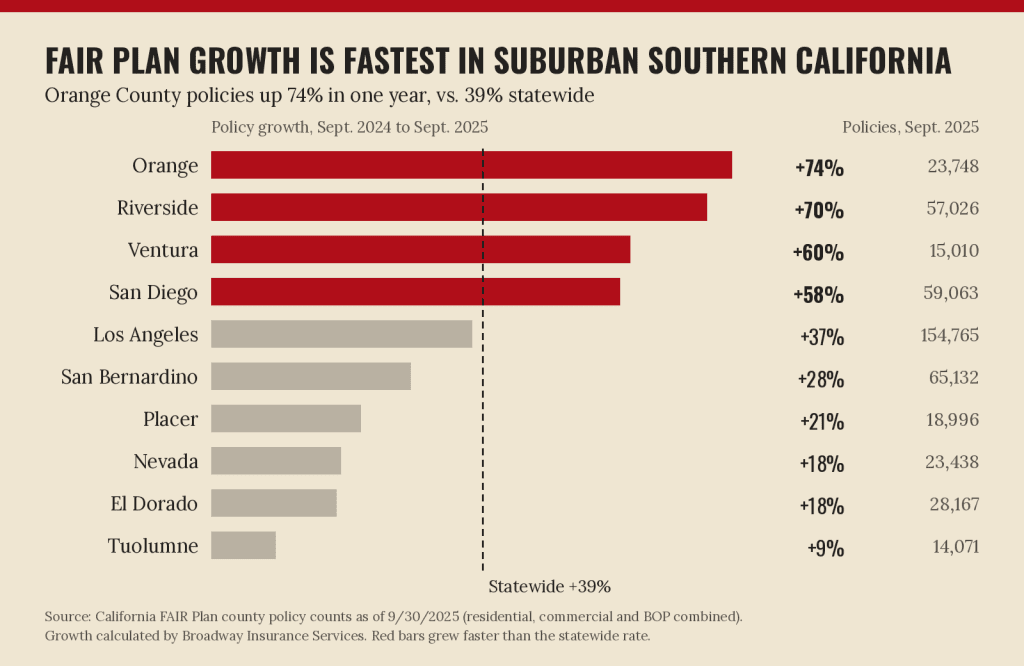
Source: California FAIR Plan county policy counts as of 9/30/2025 (residential, commercial and BOP combined). Growth calculated by Broadway Insurance Services.
Every county growing faster than the state sits in Southern California’s suburbs. These are commuter-belt counties, not the Sierra foothills. The foothill counties that defined the FAIR Plan five years ago (El Dorado, Nevada, Placer and Tuolumne) grew just 9% to 21%. If you live in Irvine, Temecula or Thousand Oaks and think the FAIR Plan is a mountain-town problem, it isn’t anymore.
What this means for your renewal. In the fast-growing counties, carriers are pulling back faster than the wildfire maps alone would explain. A clean roof and no claims no longer guarantee a renewal. Start shopping 90 days out even if you’ve never had a problem. If you own rentals in these counties, our guide to rental property non-renewals in California covers the landlord side, including loss of rents and liability.
Is your home protected by a non-renewal moratorium?
After a declared wildfire emergency, the Insurance Commissioner can bar insurers from non-renewing homes in and next to the fire perimeter for one year. If your ZIP code is on a bulletin and you got a non-renewal anyway, call your carrier and the Department of Insurance.
Fire Counties Protection starts. Lasts until CDI bulletin Gann Fire Calaveras Aug. 6, 2026 Aug. 6, 2027 2026-6 Gifford Fire San Luis Obispo, Santa Barbara Dec. 23, 2025 Dec. 23, 2026 2026-1 Pack Fire Mono (plus one Inyo ZIP) Dec. 9, 2025 Dec. 9, 2026 2025-17
The 2025 Los Angeles fire moratoriums (Palisades, Eaton, Hurst) expired one year after their January 7, 2025 declarations. New bulletins follow each declared fire, so check the Department of Insurance moratorium page for your ZIP before you assume you’re exposed.
Why you got non-renewed (it probably wasn’t you)
Most non-renewals we see in 2026 have nothing to do with the homeowner. The carrier shrank its exposure in a ZIP code, and your house was in it. The pullback is no longer limited to rural fire country; it has reached urban and suburban areas (Insurance Journal on the SLACAL report). That matters, because a ZIP-code decision by one carrier says nothing about whether the next carrier will write you.
When it is about the house, it is usually one of these:
-
Wildfire score. The carrier’s model puts your address above its appetite. This is the most common reason and the hardest one to argue.
-
Roof age and material. Many admitted carriers decline roofs past 15–20 years or wood shake at any age.
-
Prior claims. Water and fire losses in the last 3–5 years narrow the field fast.
-
Distance to fire hydrant or station. Hillside and rural homes get rated on access.
-
Vacancy or occupancy changes. A home that became a rental or sits empty often gets re-underwritten at renewal.
California law requires at least 75 days of written notice with the reason stated (FireRoofs guide). Read that reason closely, because it tells your broker which market to go to next.
Three things to do with the letter before you shop
-
Check the notice date. If you got fewer than 75 days, or no reason was stated, the policy stays in force on the same terms for 75 days from the notice date. That buys you time.
-
Ask for your wildfire risk score. Since 2022, California rules require insurers that use a wildfire score to disclose it to you and offer a way to appeal it. If the score is driving the decision and your home has been hardened, appeal it in writing with photos.
-
Check for a moratorium. If your ZIP is on a current bulletin (see the table above), the carrier generally can’t non-renew you yet.
If the home is owned in an LLC or trust, make sure the replacement policy names the right insured. A mismatch can cause real problems at claim time (LLC-owned rental property insurance).
Your three real options, ranked
Try them in this order: admitted carrier first, surplus lines second, FAIR plus DIC last.
OptionWhat it coversProsConsBest for 1. Admitted carrier (back under the Sustainable Insurance Strategy)Full homeowners form (HO-3/HO-5)One policy; backed by the California Insurance Guarantee Association; regulated ratesLimited appetite in high-risk ZIPs; rates rising; new business still selectiveHomes with newer roofs, clean loss history, moderate fire scores 2. Surplus lines (E&S) homeownersFull homeowners form, terms vary by carrierOne policy; writes fire-exposed homes, older roofs, prior claims; often priced at or below FAIR + DICNo guarantee-fund backing; forms vary, so read exclusions; broker must first show the admitted market said noNon-renewed homes the admitted market won’t touch 3. FAIR Plan + DIC wrapFAIR: fire, lightning, internal explosion, smoke. DIC: water, theft, liabilityAlways available; $3 million combined residential limitTwo premiums, two deductibles, two claims; 29.1% average FAIR increase now in effectThe last resort, as a bridge
The admitted market is moving again. By August 2026 the Department of Insurance counted 11 homeowners insurance groups filing under the Sustainable Insurance Strategy, including Farmers, Mercury, CSAA, USAA, Liberty Mutual and Travelers (California Department of Insurance, August 14, 2026). Under that strategy, insurers that use catastrophe models in their rates must write at least 85% of their statewide market share in wildfire-distressed areas. For more, see what the admitted market’s return means for property owners.
Surplus lines is no longer just for mansions. In 2025 the average assessed value of new surplus lines homes fell to $800,000 from $900,000, and average premiums fell 14.5% (Insurance Journal). The key is the carrier’s financial strength: an A-rated E&S carrier is not a gamble, and an unrated one is. We break down how to judge one in Admitted vs. Non-Admitted Insurance: Is E&S Actually Safe?
How to get off the FAIR Plan: 6 steps
Start 60 to 90 days before renewal. Most homeowners start two weeks out, and by then the best options have run out of time.
-
Read the non-renewal reason. Wildfire score, roof, claims or vacancy each point to a different market.
-
Pull your paperwork. Gather your current declarations page, a 5-year claims history (your CLUE report), the roof’s age and material, and receipts for any roof, electrical, plumbing or HVAC updates.
-
Harden the home and document it. The state’s Safer from Wildfires framework credits items such as a Class A fire-rated roof, ember-resistant vents, enclosed eaves, a noncombustible zone around the house and defensible space. Photograph everything, because underwriters credit only what they can see. Planning upgrades anyway? See 7 renovations that can affect your home insurance rates.
-
Shop the admitted market first. Surplus lines requires your broker to show the admitted market declined, so this step happens either way.
-
Then shop surplus lines. Compare the full annual cost against FAIR plus DIC, not just the premium. Read the exclusions line by line.
-
If FAIR is the only answer, build it right. Add a DIC policy for water, theft and liability. Keep dwelling, other structures, contents and living expenses under the $3 million combined limit. Then put the address back in front of the market at every renewal.
The FAIR Plan itself says that if coverage is available in the traditional market, the FAIR Plan is not right for you (California FAIR Plan, how to apply).
A broker’s take
Five things hold up in practice, whatever your county or carrier:
-
Treat the FAIR Plan as a bridge. Eligibility changes as more carriers file under the Sustainable Insurance Strategy, so re-shop the address at every renewal.
-
Compare total cost, not premium. Surplus lines is often a fuller policy at a similar price to FAIR plus DIC. Line up the annual cost, deductibles and exclusions side by side.
-
Your deadline is 90 days before renewal. Underwriting questions, inspections and the 75-day notice window all eat time.
-
Mitigation only counts when it’s documented. Keep dated photos, receipts and any defensible-space inspection report in one file.
-
Count the deductibles. With FAIR plus DIC, one loss can mean two deductibles, two adjusters and two claim files.
Not sure which option your address qualifies for? An independent broker with admitted and surplus lines access can review your declarations page and lay out the choices.
FAQ
How much did California FAIR Plan rates go up in 2026?
The approved average is 29.1% for dwelling policies, effective October 15, 2026, on new and renewal policies. Homes with higher wildfire risk see more, and some see a decrease (InsuranceNewsNet).
How many homes are on the California FAIR Plan?
696,562 policies through June 2026, up from 242,440 in September 2021 (California FAIR Plan).
What doesn’t the FAIR Plan cover?
A FAIR dwelling policy covers fire, lightning, internal explosion and smoke. Water damage, theft and liability need a separate DIC policy (California FAIR Plan, DIC).
What is the maximum FAIR Plan coverage?
$3 million combined for a residential property, including dwelling, other structures, contents and living expenses.
Is surplus lines homeowners insurance safe?
Surplus lines carriers are not backed by the California Insurance Guarantee Association, so carrier ratings matter. Many are rated A or better by AM Best. Ask your broker for the carrier’s rating and read the exclusions. More detail: Is E&S actually safe?
Can I leave the FAIR Plan mid-term?
Yes. You can cancel when a new policy binds, and unearned premium is returned pro rata. Never cancel before the replacement is bound in writing.
Does hardening my home lower my premium?
Yes, on both the FAIR Plan and admitted carriers that follow Safer from Wildfires. The FAIR Plan discount applies to the wildfire portion of the premium.
Can I appeal my wildfire risk score?
Yes. California rules require insurers that use a wildfire score to disclose it and provide an appeal process. Appeal in writing, with photos of every mitigation measure.
Why is there a FAIR Plan fee on my regular homeowners bill?
After the 2025 Los Angeles fires, the FAIR Plan assessed its member insurers $1 billion, and insurers may recoup part of it from policyholders. The Department of Insurance put the median homeowner fee at $28 a year (CDI, July 1, 2026).
I’m a landlord. Does any of this change for a rental?
Yes. A rental needs a dwelling fire or landlord form with loss of rents and premises liability, and FAIR Plan rental policies need a landlord DIC. See our guide to California rental property non-renewals.
Use this data: methodology, citation and sources
Free to use with credit. Reporters, bloggers and other agents may republish the county chart and figures with a link back to this page.
Suggested citation: Source: Broadway Insurance Services analysis of California FAIR Plan county data (Sept. 2024 vs. Sept. 2025). broadwayinsurance.agency
Methodology. County growth compares the FAIR Plan’s published policy counts at September 30, 2024 and September 30, 2025 for its ten largest counties. Counts include residential, commercial and businessowners policies combined, as the plan publishes them. Percentages are our own calculation. Statewide totals come from different FAIR Plan releases with different dates and are not averaged.
Media contact. Broadway Insurance Services, (213) 221-1247, CA license #0J21932
Sources
-
California FAIR Plan: Policy Growth by Fiscal Year, Data by County (as of 9/30/2025)
-
California FAIR Plan: Key Statistics and Data (through June 2026)
-
InsuranceNewsNet / Orange County Register: FAIR Plan rates going up 29.1% (May 20, 2026)
-
Insurance Journal: “Structural Shift” in California surplus lines (Feb. 11, 2026)
-
California Department of Insurance: Release 027 (Aug. 14, 2026)
-
California Department of Insurance: Release 022 (July 1, 2026)

